
By Jack Kalucki — Nitrex Metal Inc., St. Laurent, Québec, Canada
Copyright © 2024 ET Foundation.
ABSTRACT. Extrusion dies undergo a series of heat-treating steps prior to manufacturing, followed by cyclic surface treatment to restore their hardness. Hot work tool steels like H13 require proper through hardening while avoiding decarburization, and multiple tempers to ensure durability and stability at extrusion temperature. However, not all heat treatments are alike, and vacuum hardening is the safest method for through hardening without problems. Additionally, tempering at high temperatures requires vacuum or atmospheric furnaces with protective atmospheres and good uniformity. In contrast, nitriding is part of a repetitive cycle. Ideally, the process should produce a perfect nitrided case with each cycle, with a compressive stress distribution aimed at minimizing die flaking and brittleness. This analysis will offer proper heat-treatment guidelines, describe types of heat-treat equipment commonly used for hardening/re-hardening extrusion dies, and explain methods to avoid costly defects in order to achieve the best die life and performance.
Introduction #
Heat treating and thermo-chemical case hardening are widely used with a variety of applications. In the case of aluminum extrusion dies, the main objectives are to provide the right set of mechanical characteristics together with core hardness, toughness, and superficially improved wear resistance.
Extrusion dies have several particularities which set them apart from other applications. First, blanks from which dies will be eventually made undergo a hardening process, followed by quenching and then immediately at least two tempering cycles. Then, finished dies are rarely nitrided once since at working temperatures they lose hardness and would wear out. Therefore, they are nitrided several times, at spaced intervals.
While there are several surface hardening techniques that can be used, including hard coatings as well as ceramic inserts, nitriding remains the most practical surface treatment option. It offers the optimal balance between enhancing surface properties and the practicality and cost of the process.
Nitriding is a case hardening process which involves the enrichment of the steel surface with nitrogen (N). The process is performed at temperatures below the critical austenitic transformation point A1, typically between 932°F-1076°F (500°C-580°C). During nitriding, atomic nitrogen is adsorbed at the surface, producing a hard and wear-resistant compound layer known as the white layer. However, due to the temperatures and the pressure at which aluminum is extruded, the nitride case tends to soften, and hardness must be restored.
In between successive extrusion/nitriding cycles, dies are subject to a series of processes that involve caustic soda cleaning, shot blasting, repolishing, and of course preheating before every time a die is used.
This article delves into factors that affect die life and performance, concentrating on the initial heat treatment but also on subsequent nitriding or ferritic nitrocarburizing cycles.
Heat Treating Process Stages #
Most aluminum extrusion dies are made from tool steels such as H11 or H13. H13 Tool Steel is a versatile type of hot work steel that contains chromium (Cr) and molybdenum (Mo). It is commonly used in both hot work and cold work tooling applications. In addition to hot work applications, H13 is also used in various cold work tooling applications. H13 is available in Electro-Slag-Remelted (ESR) and Vacuum-Arc-Remelted (VAR) products as well. These remelting processes improve the chemical homogeneity, refine the carbide size, and enhance the mechanical and fatigue properties of the steel. The hot hardness of H13 makes it resistant to thermal fatigue cracking that occurs due to repeated heating and cooling cycles in hot work tooling. Its combination of high toughness and resistance to thermal fatigue cracking makes it a popular choice for hot work tooling applications.
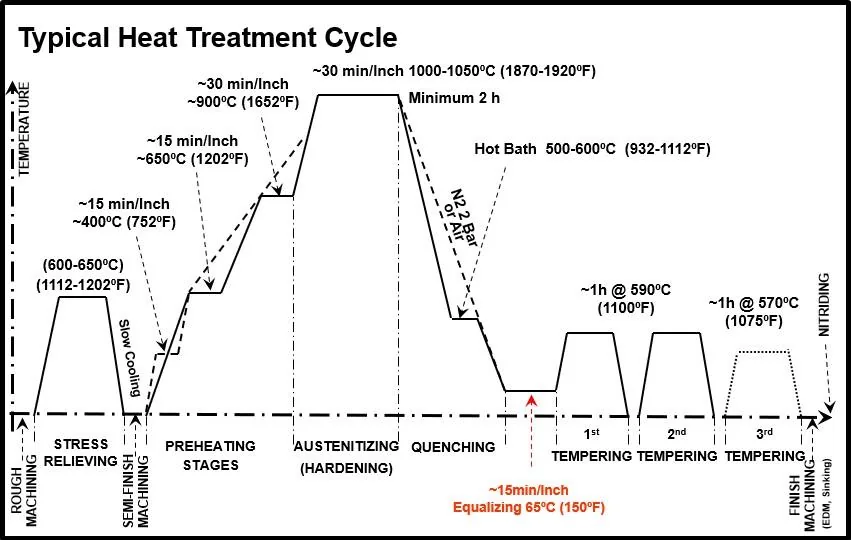
To minimize distortion in complex tools, a double preheating process is recommended. The blank should be heated at a controlled rate to a temperature range of 1150°F-1250°F (621°C-677°C), equalized, and then raised to a higher temperature range of 1500°F-1600°F (816°C-871°C) and equalized again. For normal tools, only the second temperature range is required as a single preheating treatment.
During the austenitizing process (high heat treatment), the tool is heated rapidly from the preheated temperature. The recommended temperature range for this process is 1800°F-1890°F (982°C-1032°C). For maximum toughness, a temperature of 1800°F (982°C) is recommended, while for maximum hardness, resistance to thermal fatigue cracking, and wear resistance, a temperature of 1890°F (1032°C) is recommended. The blank should be soaked at the austenitizing temperature for 30 to 90 minutes.
For quenching, options include using air, pressurized gas, or warm oil. Blanks with section thicknesses up to five inches (127mm) can be fully through hardened by cooling in still air from the austenitizing treatment. However, sections thicker than five inches will require accelerated cooling using forced air, pressurized gas, or interrupted oil quenching to achieve maximum hardness, toughness, and resistance to thermal fatigue cracking. Pressurized gas quenching (usually 2Bar) requires a minimum quench rate of approximately 50°F per minute (28°C per minute) to below 1000°F (538°C) to obtain optimal properties. Although “air quenching” may be used for tool steels, it may lead to severe and deep-reaching decarburization, discussed later.
After quenching, tempering should be done immediately. The typical tempering range for H13 Tool Steel is 1000°F-1150°F (538°C-621°C). The tool should be held at the tempering temperature for 1 hour per inch (25.4mm) of thickness, with a minimum of 2 hours, and then air cooled to ambient temperature. Double tempering is necessary. To maximize toughness and tool performance, a third tempering process is often used as a stress relief after all finishing machining, grinding, and electrical discharge machining (EDM) plus machining post-EDM work on the tool are completed. Those cycles may be performed in a vacuum-tempering furnace.
Defects Stemming from Heat-Treating #
Several defects relate to the metallurgical characteristics created during the hardening and tempering process. They can potentially cause failures, and thus, when examining a failed die, it is crucial to first analyze the heat treatment procedures. The aim of heat treatments for extrusion tools is to strike a balance between wear resistance, which requires high hardness, and toughness, which requires lower hardness. It is necessary to exercise caution to ensure that neither of these opposing properties is overly enhanced, particularly for extrusion dies. The core hardness is usually between 48HRC and 52HRC. Because dies do deflect, a higher degree of hardness would lead to breakage, while softer dies would not withstand the pressure and mechanical loading. Depending on the type of furnaces used, temperature control may not be perfect, or to be more precise, temperature may not be uniform throughout the load. The second issue relates to decarburization. Even though H13 can be air quenched, and some heat treaters used a “flash carburizing plus shot peening” method to minimize it, there is a risk of decarburization running as deep as 50-100 microns below the surface. Some of these defects may remain after grinding and initiate die failures during extrusion, when dies are subjected to high pressure.
In order to prevent this, accurate temperature measurement and control, as well as the use of protective atmospheres (or vacuum) to maintain surface integrity, are necessary. Failure to do so may result in surface decarburization with tensile residual stresses, as evidenced in Figure 2.
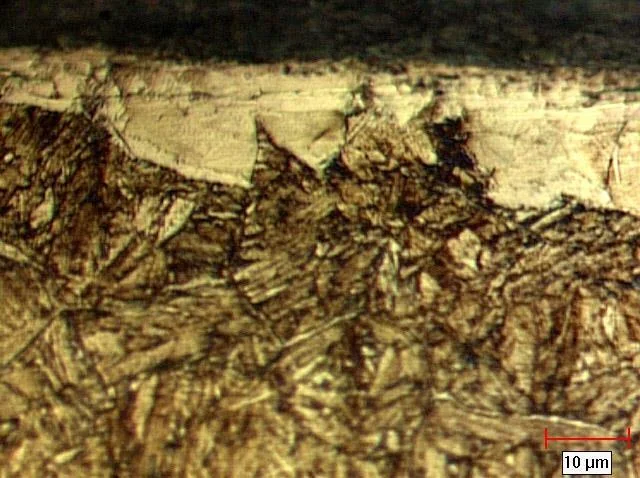
Prior to nitriding, it is imperative to eliminate this flawed microstructure in its entirety, as failure of the die will inevitably occur during use. Various failure mechanisms are possible, but typically, it can be assumed that, under applied stress, cracks arise in the decarburized layer, starting at surface defects, advancing through the diffusion layer, and ending at the edge of the matrix where applied stresses are minimized (see Figure 3).
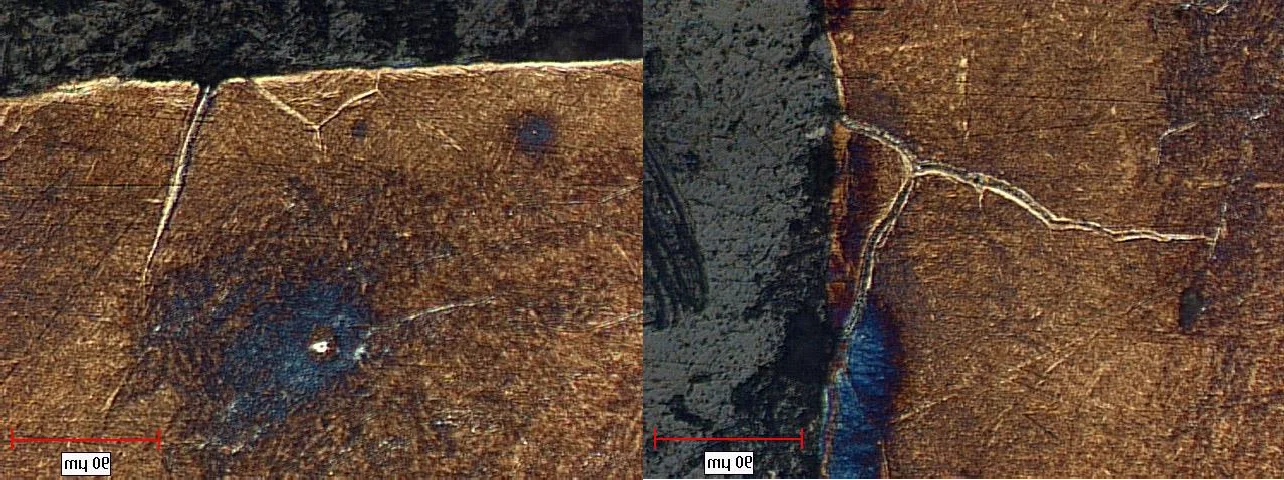
The presence of a decarburized layer with microcracks may be the combination of lack of protective atmosphere or vacuum during hardening and excessively high quenching temperatures, lack of temperature uniformity within parts (due to inadequate preheating times or excessive heating rates) or transferring parts to the tempering furnace when they are cold.
Subsequently, cracks are removed by grinding. However, if the heat treatment is inadequate, grinding can exacerbate the situation. Even when heat treatment is satisfactory, cracks may develop due to a dull or overloaded wheel or ineffective use of coolant. When the crack’s internal surfaces are exposed to the nitriding medium, they become more brittle, increasing the likelihood of die failures, as shown in Figure 3.
Die Making #
The first set of factors includes elements such as mechanical design, steel grade, and machining and grinding methods, which are critical because neglecting any one of them can diminish the die’s performance, despite subsequent treatments and operations. Of particular importance is the selection of a steel grade that satisfies the essential requirement of maintaining good mechanical properties at working temperatures that may exceed 500°C (932°F) for extrusion dies, also known as hot strength. It is important that the steel meets certain quality standards, such as those established by the North American Die Casting Association (NADCA) or the German evaluation chart (Stahl-Eisen Prufblatt). The microstructure’s homogeneity is the key criterion that distinguishes a superior steel-making process from an inferior one, as it determines the steel’s metallurgical quality. We have discovered that non-homogeneous microstructures with coarse particles, including carbides and sulfide segregations, are typically to blame for premature die failures. Figures 4a and 4b display examples of poor steel quality with relatively large carbides and sulfides that can reach several tens of micrometers (~0.003 inch). These phases cannot be nitrided, and their presence creates discontinuities in the nitride layers, leading to their degradation, as shown in Figure 4b. The consequences of this degradation can be catastrophic for die performance.
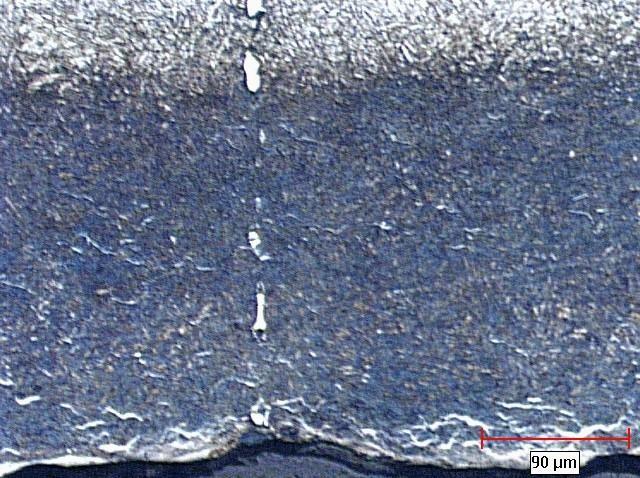
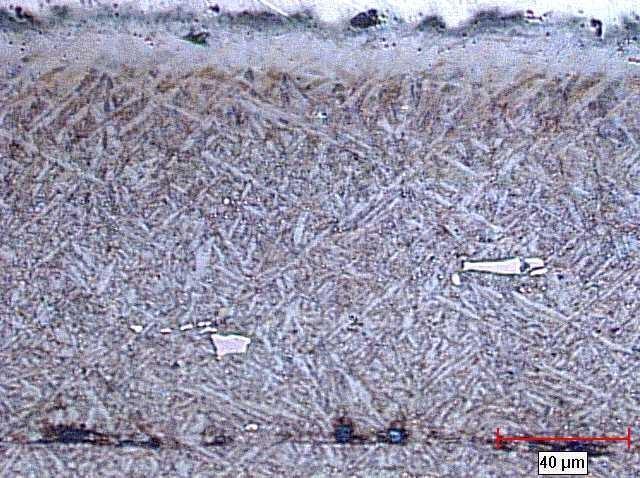
EDM sinking or shaping is used for recessed areas and bearings, following heat treatment, grinding, and machining. If executed improperly, at excessively high rates, it can result in defective layers of recast metal. This layer is characterized by a rough and irregular aspect, constituting a non-tempered martensite zone (as displayed in Figure 5). The lattice within this zone is highly distorted, creating significant tensile stresses. Consequently, microcracks and craters appear on the surface.
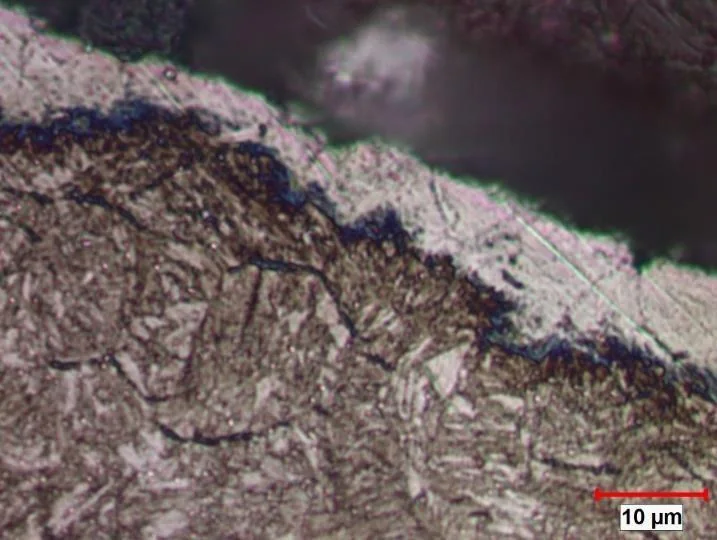
Some die failures are connected with faulty EDM layers. If left unremoved, these layers can lead to uneven nucleation of the nitride layer and ultimately result in non-uniform nitride layers.
Nitriding as Part of Die Management System #
A finished aluminum extrusion die has undergone several heat-treating and manufacturing operations. The last one is usually nitriding, or nitrocarburizing. It allows one to raise surface hardness well above 1100HV, higher than 70HRC, to withstand wear and abrasion by aluminum. The depth of this case is usually limited to 100 microns or 0.004in. It is possible to nitride H13 to over twice this depth, however while in service a die will deflect, and needs a combination of hardness, toughness as well as ductility. Otherwise, the die might simply break.
Nitriding and ferritic nitrocarburizing are thermo-chemical processes, differentiated from heat-treating by the fact that atomic or nascent nitrogen forms different chemical compounds with iron and alloying elements. Those compounds have specific chemical and mechanical properties.
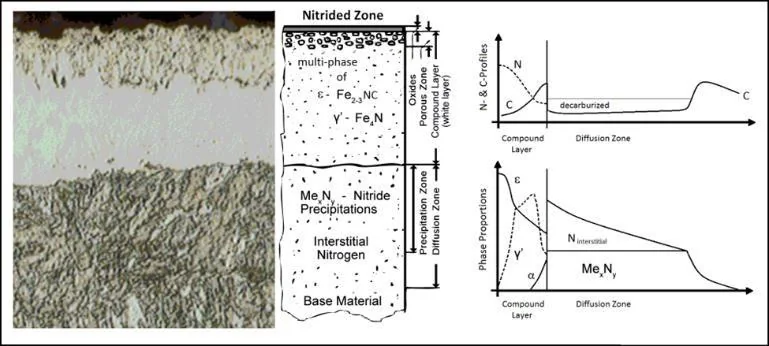
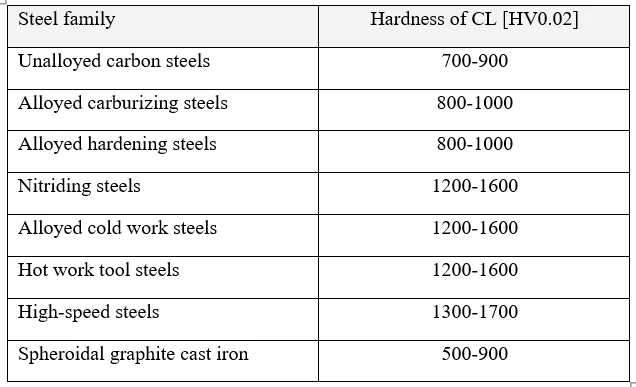
On the very top of an extrusion die one will find the white layer. It is called “white” because it appears white under a microscope, composed of Fe2-3N (ε-phase) and Fe4N (γ’-phase) iron nitrides. This quasi-ceramic tends to have a very low coefficient of friction, therefore may be beneficial if kept within a low thickness range. In hot work tool steels, the white layer hardness reaches 1200-1600 HV0.02, as shown in Table 1.
In alloy and tool steels, alloying elements such as Cr, Mo, and vanadium (V) react with N to form temperature-stable nitrides in the diffusion layer below the top white (or compound) layer. The diffusion layer is a result of the precipitation of alloy-element nitrides within the base material matrix and provides additional strength as well as toughness. The hardening effect is highest at the surface and gradually decreases towards the core (see Figures 6 and 7).
Hardness in HV #
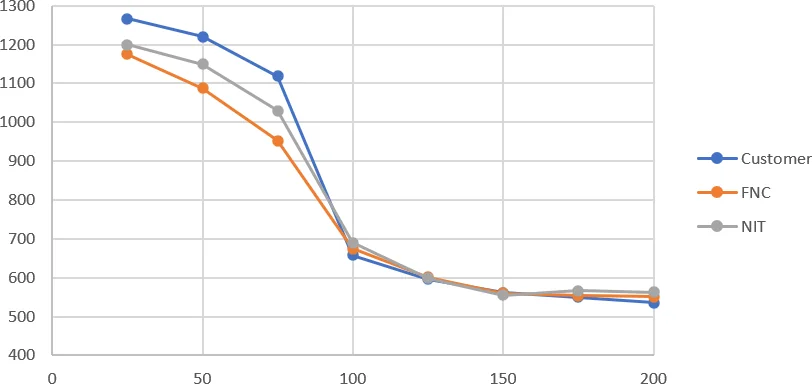
The uniqueness of nitriding is that this thermo-chemical process is repeated several times over the lifespan of a die, as it loses surface hardness during the extrusion process. This makes nitriding a key factor in prolonging the lifespan of extrusion dies because it restores the surface quality necessary for higher productivity rates.
However, nitriding is often blamed for die failures. The fact is that nitriding can cause defects or reveal pre-existing issues. There are several nitriding technologies, some having inherent flaws.
The salt-bath process, known under several trade names, used to be commonplace but has become relatively rare today. This ferritic nitrocarburizing process has one common issue which is the formation of an excessively thick, porous white layer and excessive roughness. The nitriding medium, which is typically molten cyanate and cyanide salts, is aggressive and quickly produces a high concentration of nitrogen in the compound layer, making it more brittle. While the salt-bath composition can be engineered for acceptable nitriding results, there is little in-process control once a part is immersed in the bath, except for time and temperature. As a result, salt-bath nitriding has been developed mainly for short-cycle processes above 550°C (1022°F). Salt bath nitriding is actually a nitrocarburizing process, which may offer some advantages, however roughness, low hardness and salt incrustation in die cavities are a handicap.
One of the common issues in plasma (ion) nitriding is the challenge of nitriding inner surfaces of narrow and deep bearings. Plasma nitriding requires precise control of pressure and current density at the nitrided part surfaces, which affects the thickness of the glow discharge. If the glow discharge is too diffuse (low pressure), it cannot enter openings or grooves, and no nitriding can occur. Conversely, nitriding these areas requires generating very thin glow seams (high pressure), which can locally cause more aggressive nitriding. If the two seams on opposite sides of a hole overlap, it can result in an intense dissipation of energy and severe overheating leading to local tempering and low hardness.
The equipment used in traditional gas nitriding is often basic, and there is minimal process control. This can result in inconsistent nitriding, depending on various factors such as part cleanliness, load size and configuration, furnace size. As a result, the performance of dies can also be inconsistent, making it challenging to predict die life and rendering the die management system ineffective. Nitriding conditions that are too aggressive, like in the salt bath process, can result in brittle white layers due to high nitrogen concentrations, which increases the risk of die flaking. Conversely, weak nitriding can lead to a soft and uneven case, causing premature die wear (washout). There is a range of possibilities between these two extremes, but usually a lack of constant and consistent results. It is easy to over-nitride H13 because of its alloying elements. This may lead to excessive white layers, and very high hardness, which is not beneficial since dies must be able to deflect. Dies are prone to developing scales, chipping. Excessive hardness is favorable to fast crack propagation.
Successful process control requires the regulation of the nitriding potential to eliminate faults. Nowadays, this parameter can be measured and controlled. The nitriding potential is a thermodynamic parameter that determines the nitrogen concentration on the surface being nitrided, thus controlling its final mechanical and structural properties. This parameter is calculated using the following formula:
KN = pNH₃ / pH₂3/2
where pNH₃ is the partial pressure of ammonia and pH₂ is the partial pressure of hydrogen in the furnace atmosphere. The aggressivity of the nitriding atmosphere can be expressed in % of ammonia dissociation or Nitriding Potential. The latter one is more precise and described in the SAE AMS 2759/10 norm for process control. To simplify, the higher the Kₙ or Potential, the more aggressive the atmosphere. At first, a high Kₙ is necessary to create a white layer, but then the Kₙ must drop, or the die is at risk of over-nitriding, with excess white layer.
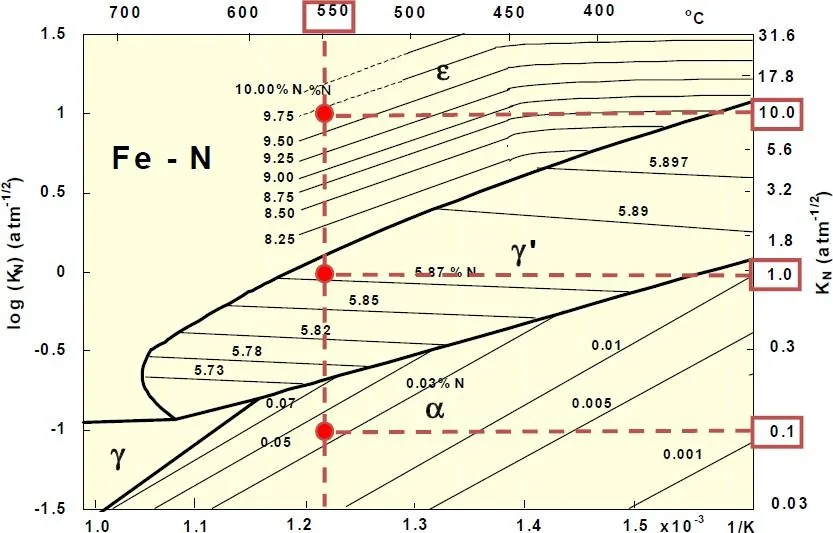
Figure 8, which shows the temperature-nitriding potential equilibrium phase diagram, highlights the significance of the nitriding potential in determining the chemical and phase constitution of the nitride surface. Nitride phases are formed within specific nitrogen concentration ranges and exhibit various properties such as hardness, load bearing capacity, brittleness, and corrosion resistance. Therefore, the surface properties are ultimately determined by the nitrogen concentration.
To perform a successful nitriding cycle, several interdependent parameters such as atmosphere composition and nitriding potential must be selected correctly, requiring expertise in various metallurgical and technical domains. Additionally, continuous, self-correcting, and fully automatic control of the nitriding potential requires the use of advanced software and control devices.
This control process is well-established and has been successfully implemented in numerous industrial applications, eliminating human error and related faults due to inadequate control. Once nitriding processes have been developed, tested, and stored in a process library within a computer system, they yield fully reproducible results every time they are executed. Removing the human error factor and having full control of the nitriding potential value ensures that the desired nitrogen concentrations are achieved on the surface, resulting in the desired properties.
Prevention of Typical Nitriding Defects #
Brittleness of the White Layer #
The occurrence of white layer brittleness is common in both salt bath and conventional gas processes.
The amount and length of cracks that form around the corners of a microhardness indentation are indicators of layer brittleness. When material is exposed to stress, it will deform until its toughness is exhausted. Therefore, a tougher material will be able to accommodate stress through deformation, while a brittle material will crack. Please note that what one perceives as “hardness” is actually a higher sum of compressive stress. If compressive stress exceeds a certain level, it may lead to stress relief cracks (and chipping).
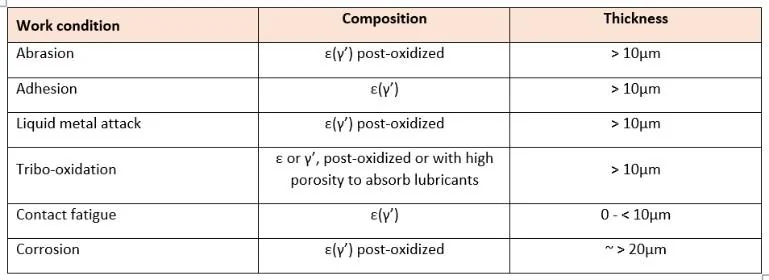
The correct thickness of the white layer for aluminum extrusion dies should be 4µm-6µm, maximum 8µm for nitrocarburizing, without any porosity or oversaturation. There are actually general guidelines for specific applications, as shown in Table 2.
Corner Effect #
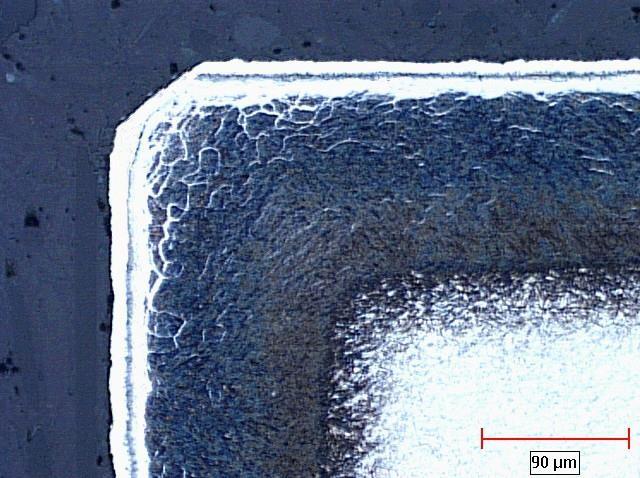
The “corner effect” occurs when nitrogen diffuses from two converging directions at the same time, creating local oversaturation. While it is impossible to avoid simultaneous diffusion, the controlled gas nitriding process can mitigate this issue by appropriately adjusting the nitriding potential, resulting in the corners of an aluminum extrusion die bearing surface being suitable for use. Figure 9 illustrates a typical corner effect.
Soft and Non-Uniform Gas Nitriding #
Soft and uneven nitriding cases are often linked to the absence of the compound layer. The problem may stem from the very beginning of the nitriding stage, when the white layer nucleates and creates a uniform base for nitrogen diffusion.
Among the common factors are contamination (suspended oils in gas, polishing compound, rust inhibitor from rinse water) or insufficient ammonia flow due to process setting, furnace contamination or over-nitrided furnace retort (porous stainless-steel retorts dissociate ammonia, leaving little for the process itself). Figure 10 shows a standard microstructure of a soft and uneven nitriding case.
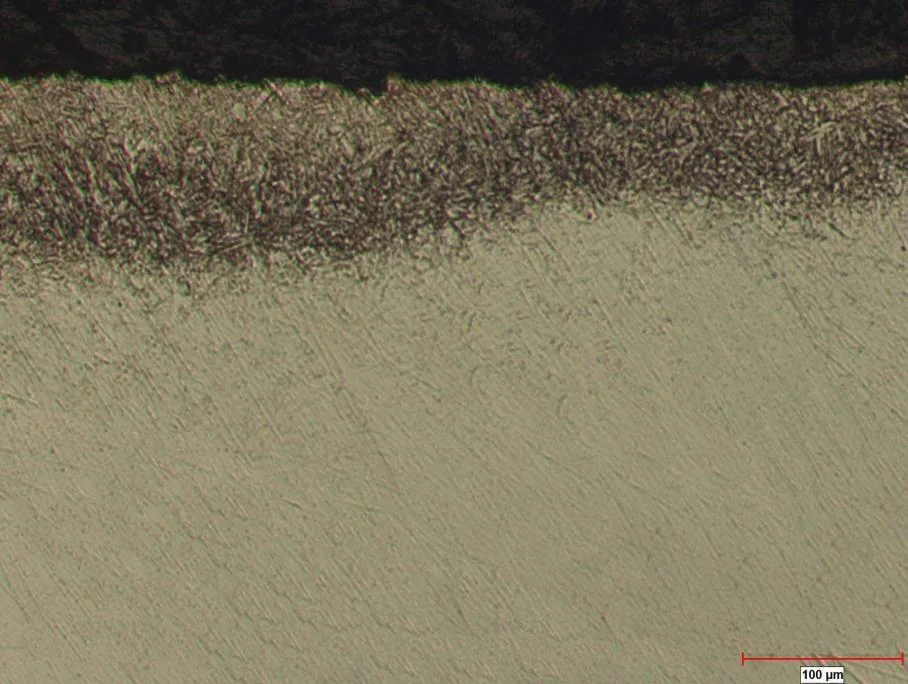
Premature wear of the bearing surface is a common outcome of such faulty nitriding microstructures.
Other Factors Affecting Die Performance #
Die Handling and Use in Service #
This set of factors involves various practices, including preheating the die before installation in the press, cleaning the die after the extrusion run to remove adherent aluminum, polishing, and correcting the die, and chemically and mechanically cleaning the die with caustic soda, among others. However, mechanical factors such as tool overloading and improper clearance and alignment, among others, which can cause tool failure, will not be discussed in this paper.
Die handling is critical, as it occurs just before the die is used for extrusion and after it has been prepared for re-nitriding.
As a result, any effort made to capitalize on the quality of previous operations, such as die making, heat treatment, and nitriding, will be lost due to die mishandling. Conversely, if all steps of die handling are performed correctly one may expect an improved die life.
Before the die is installed, it is preheated to approximately 480°C (896°F). Uniform temperature throughout the heating process is necessary, and temperature differences within the die volume should not exceed 5°C-7°C (9°F-12°F). The die’s surfaces should not oxidize, and there should be no degradation of the die’s mechanical properties (no overheating). As a general rule, the holding time in the preheating oven should be limited to 3-6 hours, but experience indicates that dies are often left in the ovens for much longer periods. Extremely thick oxide layers are frequently observed on the surface of dies that flaked during extrusion, and sometimes oxidation is combined with other defective features.
Nitrex has studied together with an extruder a range of temperatures (450°C-600°C or 842°F-1112°F) and times (2h to 25h) and found that the buildup of the oxide layer on H13 steel can be significantly reduced by using a protective atmosphere of nitrogen. The use of nitrogen extended the allowable preheating time and protected the nitrided surface against oxidation, as demonstrated by the microstructures of nitrided layers on H13 steel shown in Figure 11. The micrograph shown in Figure 11 underlines the fact that oxidation is not uniform and will follow the easiest path, often following intergranular diffusion, thus compromising the structure of the die.
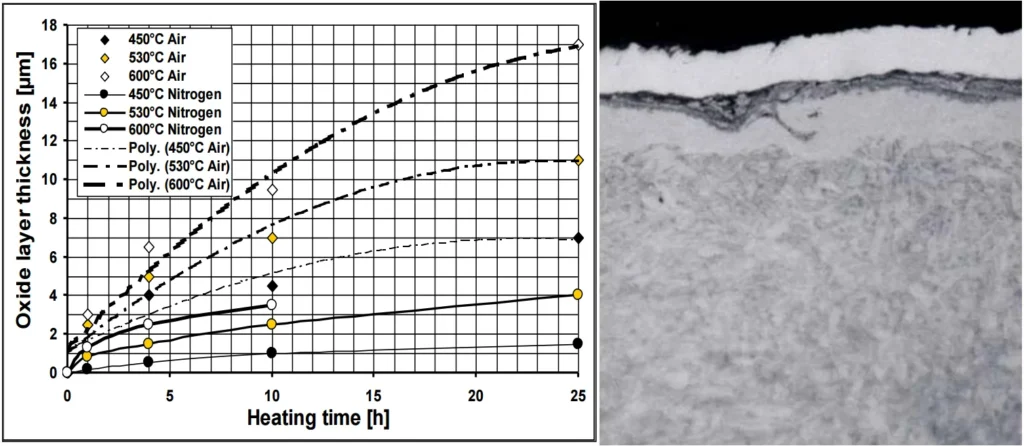
To minimize the negative effects of preheating, it is recommended to place strict limitations on preheating times or to preheat dies in a protective atmosphere of nitrogen.
Re-nitriding of dies with pits and oxidized structures may exacerbate the problem which originated during unprotected preheating.
The removal of the residual billet at the end of an extrusion run is often overlooked as a factor that can affect die quality and performance. To remove the 25mm-thick residue of aluminum that adheres to the die, a knife edge is used to shear it off while moving parallel to the die face. However, faulty shearing operations have caused problems in two extrusion plants. In one plant, a dull shear edge caused tearing of the billet butt, which also ripped off parts of the nitrided surface of the die.
Sharpening the knife edge resolved the issue.
As more extrusion plants are opting for in-house nitriding due to its practicality and cost-effectiveness, this approach requires close collaboration with the nitriding technology supplier, as the extrusion plant may lack the technical know-how to troubleshoot nitriding issues. In such situations, the competence and involvement of the nitriding technology supplier become critical factors in the success of the entire extrusion process. Consequently, it is crucial to invest in high-quality equipment, but even more important to seek a supplier that is devoted to delivering prompt technological and technical remedies and steadfast support.
Discussion #
In this paper one has seen that heat-treating has an important impact on die life. Nitriding or nitrocarburizing treatments provide initial hardness and restore hardness as well as toughness to aluminum extrusion dies.
However, those heat-treating operations are only a part of a larger cycle in the life of a die. Once a die is manufactured it undergoes die handling loops that incorporate preheating-extrusion-caustic soda-shot blast-re-nitriding – eventually polishing, and then a new cycle of pre-heating, extrusion, etc.
Each of these operations may have a negative effect: excessive pre-heating times (or insufficient/non-uniform preheating), contamination in caustic soda or rinse water, re-nitriding too early or too late may lead to additional defects, corrections, and shortened die life.
Therefore, one should perhaps look at the complete cycle rather than a single operation to improve die life. Once a die is heat treated, manufactured and nitrided, a whole new potentially damaging set of factors must be taken into consideration.
Conclusion #
Initial die heat treating using vacuum furnaces and vacuum-tempering furnaces is the very basic requirement for a long-lasting extrusion die without defects stemming from deep decarburization. The right re-nitriding process as well as nitriding schedule helps protect the die from subsequent wear and loss of surface hardness during extrusion cycles.
Based on our experience with die failures — which we analyze as both heat-treaters and suppliers of nitriding and vacuum furnaces — we believe that die life should be viewed as part of a holistic die management system. As a matter of fact, when die failures are not caused by nitriding, die handling is often the source of the problem.
With a fully repeatable controlled nitriding process and well-managed die preheating and caustic soda processes, it is possible to pin-point areas of improvement relying on production statistics. Keeping in mind that tooling and tooling-related costs have an immediate impact on the bottom line, understanding heat treating and its implications is key to improved productivity and performance.
Acknowledgments #
Special thanks to Mr. Mario Morissette, Plant Manager, and Paulo Abrantes, R&D Technology Specialist, Nitrex Metal Inc. Montreal, for their input on heat-treatment and all micrographs contained in this paper.
References #
- Bruce Becherer, Thomas J. Witheford: “Introduction to Heat Treating of Tool Steels,” ASM Handbook, Vol. 4, Steel Heat Treating Fundamentals and Processes, ASM International, 1995, pp. 711-725
- K.-M. Winter, J. Kalucki: “Gas Nitriding and Gas Nitrocarburizing of Steels,” J. Dosset and G.E. Totten (Eds.), ASM Handbook, Volume 4A, Steel Heat Treating Fundamentals and Processes, ASM International, 2013, pp. 647-679.
- R. Jonck, G. Kunze: “Gefügeausbildung und Härte von Verbindungs- und Diffusionsschichten bad- und gasnitrierter Werkzeugstähle,” Zeitschrift für wirtschaftliche Fertigung, Vol. 73, Heft 4, 1978, pp. 213-220.
- Automated Gaseous Nitriding Controlled By Nitriding Potential, SAE AMS 2759/10B-2018,
- W. Liliental, G. Tymowski: “Bringing out the Best Properties of Nitrided Layers Through Controlled Gas Nitriding,” Conference: Carburizing and Nitriding Technology and Applications, SME, Cleveland, Ohio, USA, May 27, 1999.


